How To Pay For Speech Therapy
One of the first questions families ask when they call is:
"Do you take my insurance?"
It's one thing to learn that you or your child could benefit from speech therapy—it's another to figure out how you're going to pay for it. Insurance can feel overwhelming, especially when you're trying to make sense of terms like in-network, out-of-network, deductibles, coinsurance, and superbills.
Throughout my career, I've helped families understand their insurance benefits and navigate the reimbursement process. My hope is that this guide makes paying for speech therapy feel a little less confusing—not just for my own clients, but for anyone looking for clear, straightforward information.
Many people assume that if a speech-language pathologist isn't in-network with their insurance company, they'll have to pay the entire cost of therapy out of pocket. In reality, many insurance plans offer out-of-network benefits that may reimburse a portion of the cost of speech therapy.
Understanding the different payment options can help you make an informed decision about what works best for you or your family.
HMO vs. PPO: What's the Difference?
Whether you already have an insurance plan or you are looking at them, you have to know if you have an HMO or PPO.
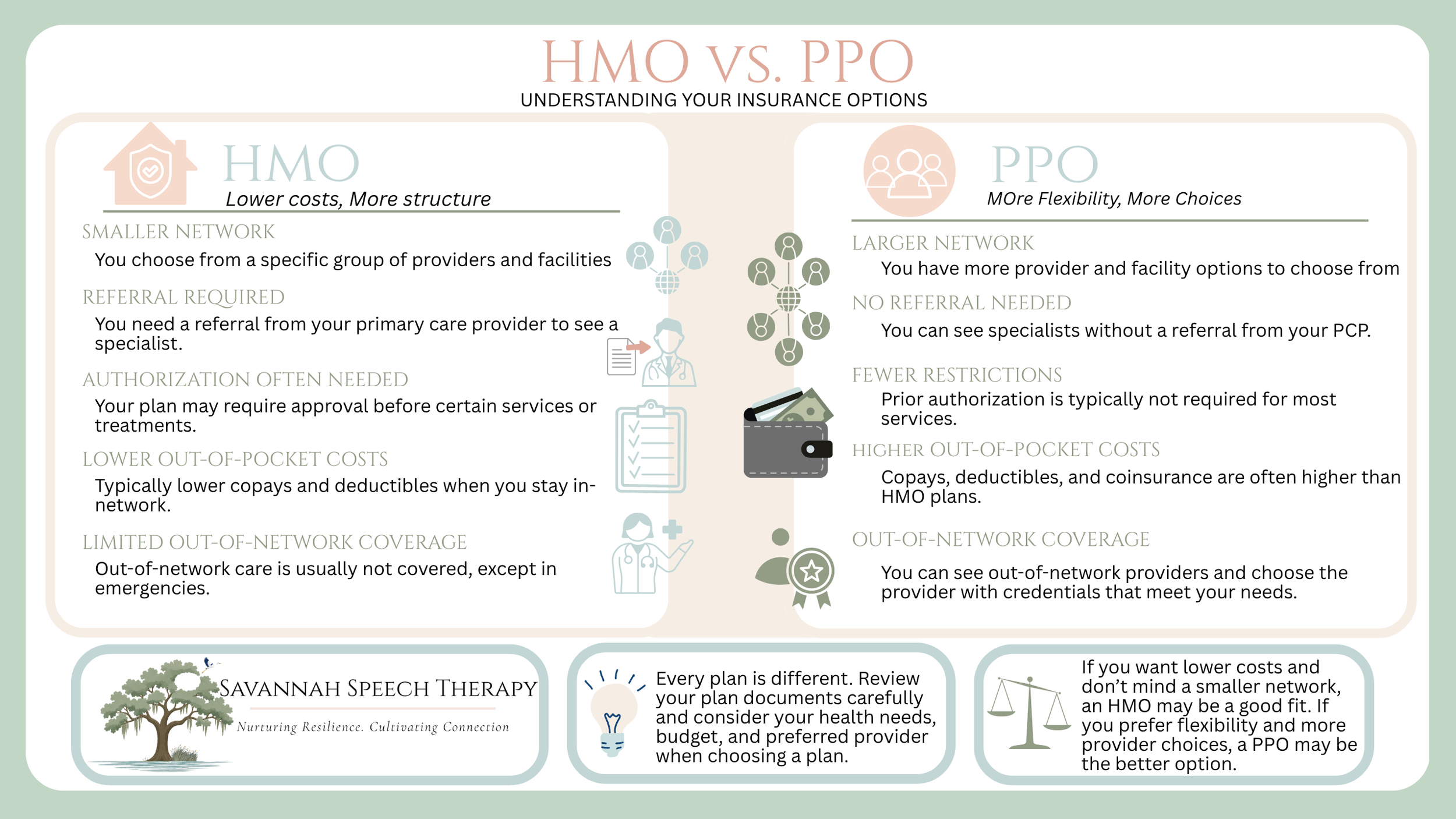
HMO (Health Maintenance Organization)
An HMO plan generally requires you to receive care from providers within the insurance company's network.
Many HMOs also require a referral from your primary care physician before seeing a specialist, including a speech-language pathologist.
If you choose a provider outside the network, the plan may not provide any coverage except in certain situations.
PPO (Preferred Provider Organization)
A PPO plan offers more flexibility.
You can usually choose from both in-network and out-of-network providers, although you'll often pay less when you stay in-network.
Many PPO plans include out-of-network benefits, which may reimburse part of the cost of speech therapy even if the provider doesn't participate with your insurance company. (We'll discuss this in the next section.)
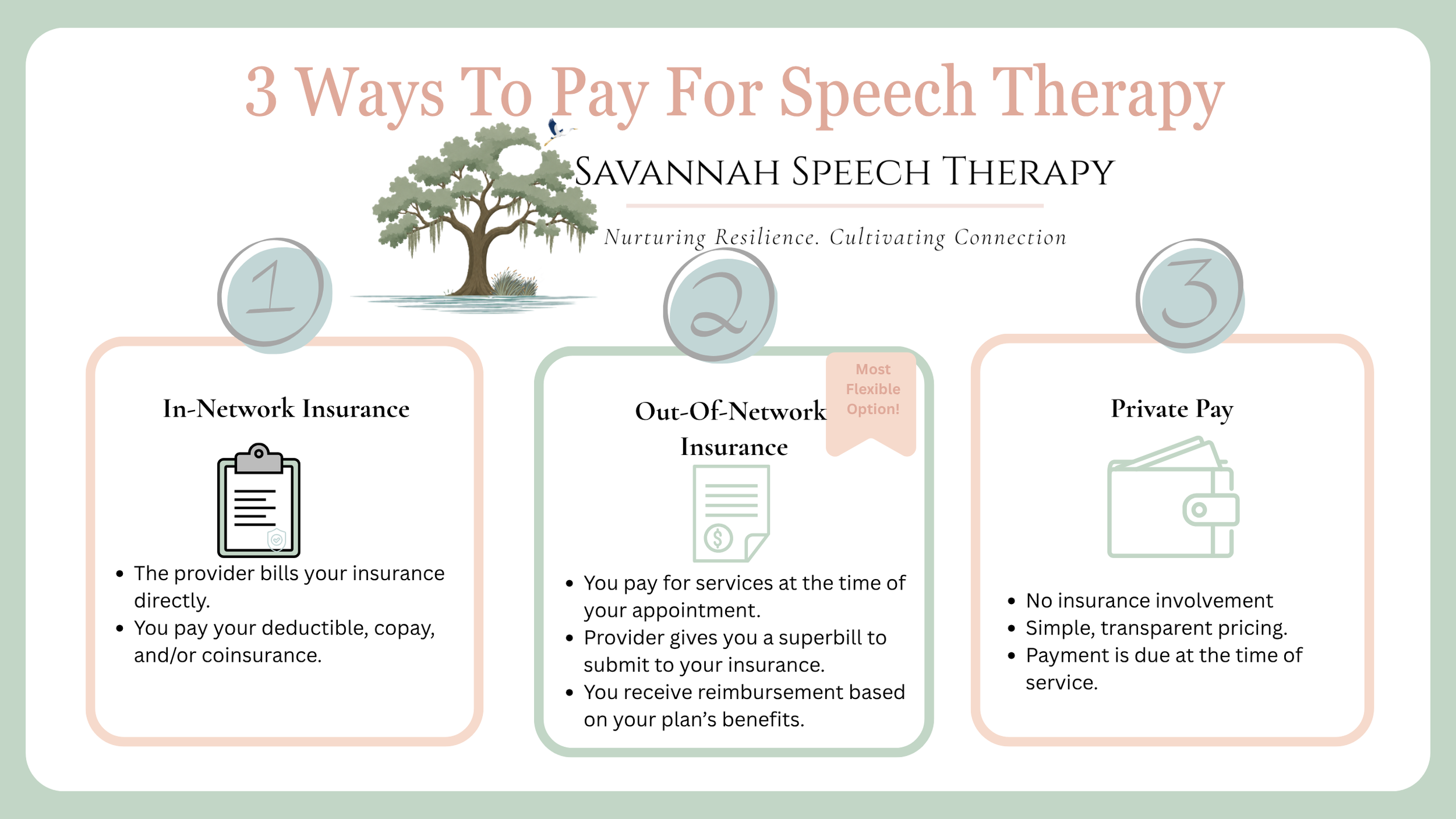
Option 1: In-Network Insurance
An in-network provider is a healthcare provider or therapy practice that has signed a contract with your insurance company. This agreement sets the prices they can charge and determines how much you are responsible for paying.
When you see an in-network provider, the office typically submits claims directly to your insurance company. Depending on your plan, you may be responsible for a copay, deductible, coinsurance, or a combination of these.
For many families, staying in-network is the simplest option because the provider handles the insurance billing.
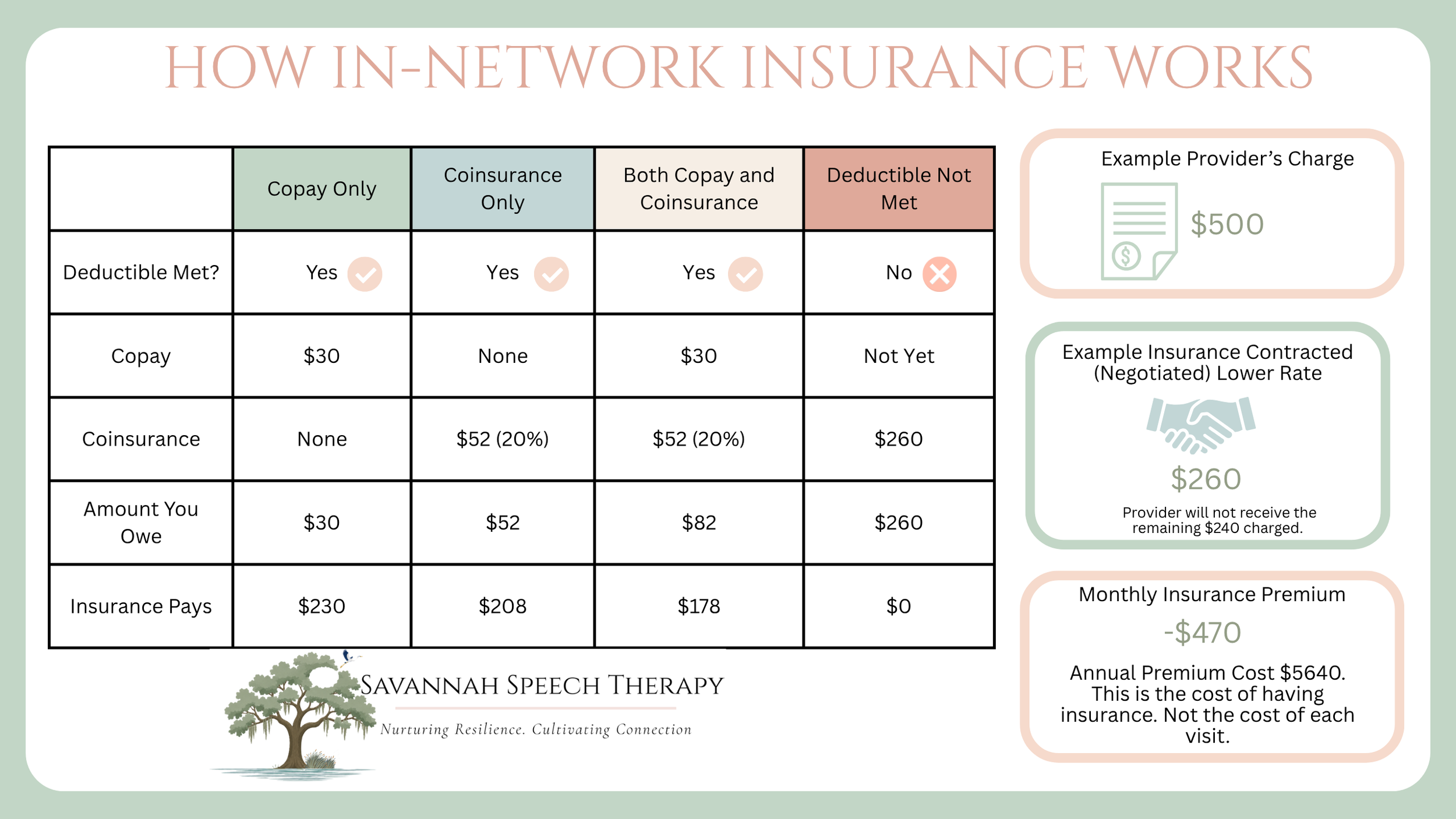
Example Scenarios
Understanding Common Insurance Terms
Copay
A copay is a fixed dollar amount you pay for each visit.
For example, your insurance plan may require a $30 copay for every speech therapy appointment, while your insurance company pays the remaining covered amount.
Deductible
Your deductible is the amount you must pay out of your own pocket before your insurance begins sharing the cost of covered services.
For example, if your deductible is $1,500, you'll generally pay the full cost of covered healthcare services until you've paid that $1,500. After that, your insurance begins paying according to your plan's benefits.
Coinsurance
Once you've met your deductible, many plans require coinsurance instead of (or in addition to) a copay.
Coinsurance is the percentage of the cost that you continue to pay.
For example, if your plan covers 80% of speech therapy, your coinsurance is 20%. If an appointment costs $150, your insurance would pay $120, and you would pay $30.
Out-of-Pocket Maximum
Your out-of-pocket maximum is the most you'll pay for covered healthcare expenses during your plan year.
Once you've reached that amount through deductibles, copays, and coinsurance, your insurance generally pays 100% of covered in-network services for the rest of the year.
This limit can provide peace of mind if you or your child requires ongoing therapy or other medical care.
Keep in mind: Premiums (your monthly insurance payment) typically do not count toward your out-of-pocket maximum.
Pros of Using an In-Network Provider
The provider bills your insurance company directly.
Lower out-of-pocket costs for many families.
Predictable copays or coinsurance.
Less paperwork for patients.
Good option if minimizing upfront costs is your highest priority.
Things to Consider
Your choice of providers may be limited.
Some plans require referrals or prior authorization.
Insurance companies may limit the number of therapy visits they will cover.
Covered services, documentation requirements, and authorization rules are determined by your insurance plan.
Appointment availability may vary depending on provider demand.
Even If You Have Insurance, Coverage Isn't Guaranteed
Having health insurance doesn't automatically mean speech therapy will be covered.
Every insurance company has its own rules about what services are covered, who qualifies, and how much therapy they'll pay for. These rules can vary not only between insurance companies, but even between different plans offered by the same company.
Some of the decisions an insurance company may make include:
Whether Speech Therapy Is Covered
Some plans cover speech therapy broadly, while others may only cover treatment for certain diagnoses or under specific circumstances.
Whether Your Diagnosis Qualifies
Many insurance companies have medical necessity guidelines that determine which diagnoses qualify for speech therapy benefits. Even if your physician recommends therapy, your insurance company may require that specific criteria be met before services are covered.
One piece of advice I give nearly every client is this: don't stop after asking, "Is speech therapy covered?"
I owned a multi-discipline therapy practice where we treated several clients with the same insurance plan. When families called their insurance company and asked whether speech therapy was covered, they were consistently told, "Yes."
Unfortunately, that wasn't the whole story.
That particular insurance plan only covered speech therapy for a very limited list of qualifying diagnoses. Although speech therapy was technically a covered benefit, claims for many of our clients were denied because their diagnosis did not meet the plan's medical necessity requirements. As a provider, we also could not access all of those details that the insurance holder could.
The insurance representative wasn't necessarily giving incorrect information—they were simply answering the question that was asked.
Instead of asking only, "Is speech therapy covered?" consider asking:
Does my diagnosis qualify for speech therapy coverage under my specific plan?
Are there any diagnoses or conditions that are excluded from coverage?
Are there medical necessity criteria that must be met before speech therapy will be covered?
Can you email or mail me the section of my policy that explains my speech therapy benefits?
Taking a few extra minutes to ask these questions upfront may help prevent unexpected claim denials later.
Understanding these limitations can also help explain why some families choose to use their out-of-network benefits. While insurance companies determine coverage for in-network services, many PPO plans also allow members to seek care outside the network and receive significant reimbursement according to their plan benefits.
How Many Visits They'll Cover
Some plans authorize a specific number of visits at a time, while others may place annual limits on therapy. Additional visits may require updated documentation or a new authorization request.
Whether Prior Authorization Is Required
Some insurance plans require approval before therapy can begin. Others may require additional authorization after a certain number of visits.
Whether a Claim Is Approved
Even after therapy has been provided, an insurance company may approve, partially approve, or deny a claim based on the terms of your individual policy.
What This Means for You
Insurance can be an important resource for many families, but it's also helpful to understand that coverage decisions are ultimately made by your insurance company—not your physician or your speech-language pathologist.
Knowing your benefits before beginning therapy can help you better understand your expected costs and avoid surprises later.
Option 2: Out-of-Network Benefits
One of the biggest misconceptions about health insurance is that you can only see providers who are "in-network."
Fortunately, that's not always true.
Many insurance plans—particularly PPO plans—include out-of-network benefits. This means you may choose to receive care from a provider who does not have a contract with your insurance company and still receive reimbursement for a portion of the cost.
Not every insurance plan includes out-of-network benefits, which is why it's always important to verify your individual coverage.
What Does "Out-of-Network" Mean?
An out-of-network provider has not signed a contract with your insurance company.
Unlike an in-network provider, there is no negotiated rate that determines what the provider must accept as payment. Instead, the provider establishes their own fees.
Many private speech therapy practices—including Savannah Speech Therapy—operate this way.
This does not automatically mean your insurance won't help pay for therapy.
If your plan includes out-of-network benefits, your insurance company may reimburse you for a portion of the cost after you meet your deductible and according to your plan's reimbursement rules.

How Does It Work?
While every insurance plan is different, the process often looks something like this:
You attend your speech therapy appointment.
Payment is made directly to the provider at the time of service.
The provider supplies a superbill upon request.
You submit the superbill to your insurance company.
If your plan includes out-of-network benefits, your insurance company will reimburse you for part of the cost.
Some insurance companies send reimbursement directly to you, while others have different processes. Every plan is different.
What Is a Superbill?
A superbill is simply a detailed receipt that includes the information your insurance company needs to process an out-of-network claim.
It typically includes:
Provider information
Diagnosis code(s)
Procedure code(s)
Date of service
Amount paid
Submitting a superbill does not guarantee reimbursement, but it allows your insurance company to determine whether your services qualify under your plan's out-of-network benefits.
Why Would Someone Choose an Out-of-Network Provider?
Choosing a speech therapist isn't just about insurance. It's about finding the right fit for your needs.
Some families choose an out-of-network provider because they value:
A therapist with experience treating a specific disorder.
In-home therapy.
Flexible scheduling.
More individualized care.
Continuity with the same therapist.
More experienced therapist.
Shorter wait times.
Longer appointment times.
A therapy approach that aligns with their goals.
For many people, these factors are worth more than choosing a provider based solely on whether they're contracted with their insurance company.
How Much Will Insurance Reimburse?
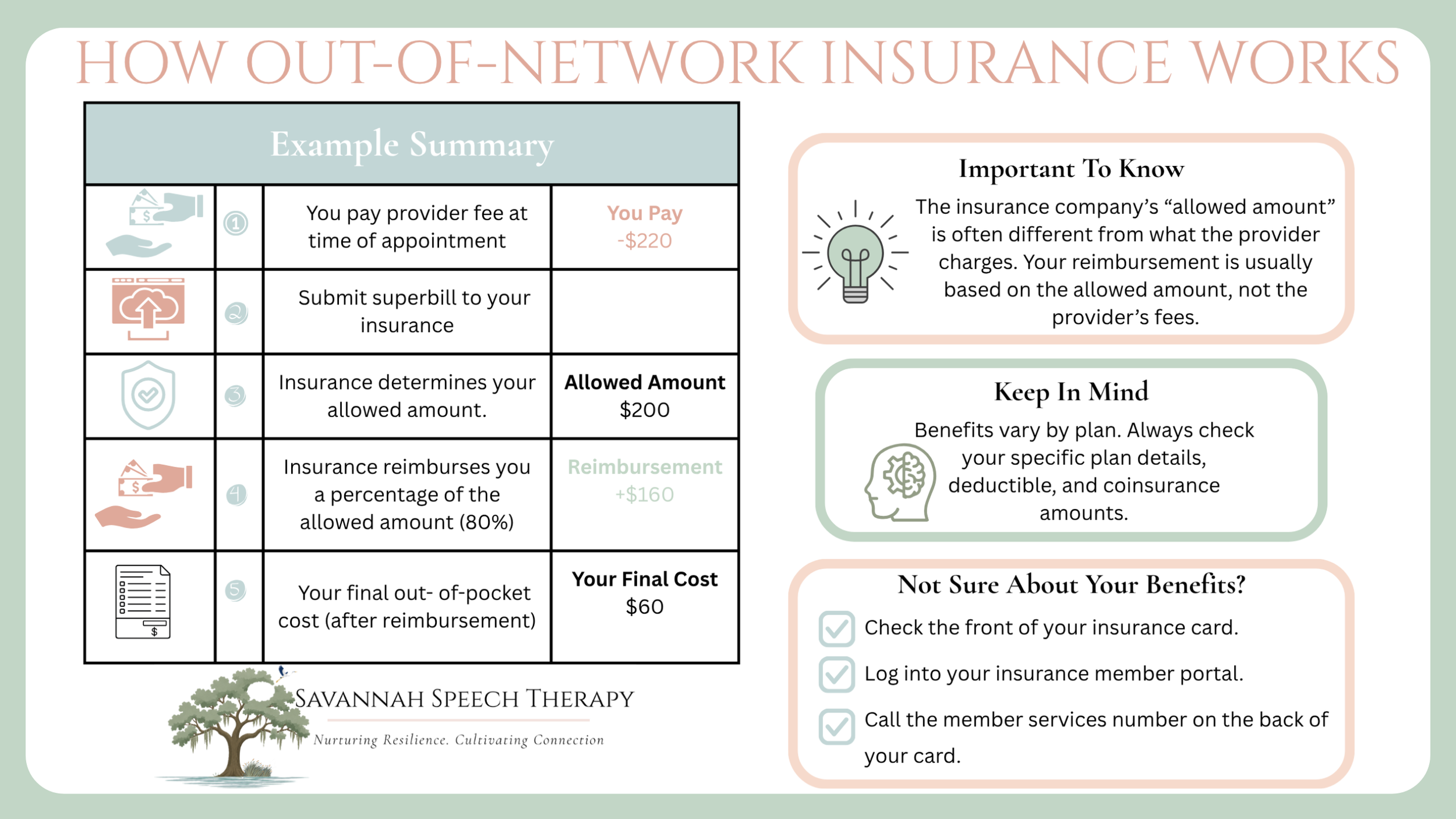
There isn't one answer. Every insurance plan is different. Some plans provide no out-of-network coverage.
Others reimburse 50%, 60%, 70%, 80% or even 90% of what they consider the allowed amount after you've met your deductible.
Because reimbursement depends on your individual plan, the best way to know what to expect is to contact your insurance company before beginning therapy.
Questions to Ask Your Insurance Company
When calling your insurance company, consider asking:
Do I have out-of-network benefits for speech therapy?
Is speech-language pathology covered under my plan?
Do I need a physician referral?
Is prior authorization required?
What is my out-of-network deductible?
Have I already met my deductible?
What percentage of the allowed amount will be reimbursed?
Is there a visit limit?
Do I need to submit a superbill?
Is there a deadline for submitting claims?
**Writing down the representative's name and reference number can also be helpful if questions come up later.
Why Doesn't Every Speech Therapist Accept Insurance?
This is one of the questions I hear most often.
Some speech therapy practices choose to participate with insurance companies, while others choose to remain out-of-network. Neither approach is inherently better—they simply operate differently.
Insurance participation often comes with contractual agreements regarding reimbursement rates (which may be below the cost of providing care), additional documentation requirements, prior authorizations, significant administrative responsibilities, and limitations on covered services or the number of visits authorized. Remaining out-of-network allows a practice to operate independently of those contracts, tailor evaluation and treatment recommendations based on clinical need rather than insurance guidelines, spend less time navigating insurance requirements, and more time focusing on individualized patient care while providing services according to its own practice model.
For many families, the most important question isn't whether a provider is in-network—it's whether they're the right provider for their needs.
What About Medicaid?
Medicaid helps millions of children and adults access important healthcare services, including speech therapy. If you have Medicaid, your first step should always be to look for a speech-language pathologist who participates with your Medicaid plan.
Because Medicaid reimbursement rates are often significantly lower than those of private insurance, fewer private practices participate as in-network providers. As a result, families may experience longer wait lists or have fewer providers to choose from in some communities.
That doesn't mean quality care isn't available—it simply means that finding a participating provider may take a little more time.
💡 Tip: If you can't find a speech therapist who accepts your Medicaid plan, don't assume therapy isn't available. Call your Medicaid plan and ask whether they can authorize care with an out-of-network provider due to network limitations. Some plans can arrange this when medically necessary.
Other Funding Sources for Speech Therapy
Insurance is not the only way to help cover the cost of speech therapy. Depending on your child’s age, diagnosis, location, and financial situation, there may be other programs available to help.
Scottish Rite / RiteCare programs have a long history of supporting children with speech and language disorders. Some programs provide services directly at little or no cost, while others may help fund care through participating clinics.
Families may also want to explore medical grants and nonprofit assistance programs, including organizations such as the UnitedHealthcare Children’s Foundation. Some foundations offer financial assistance when insurance does not fully cover recommended services.
Other options may include school-based speech therapy, Early Intervention programs such as Georgia’s Babies Can’t Wait or California Regional Centers, Medicaid or CHIP, university speech and hearing clinics, HSA/FSA funds, and provider payment plans or reduced-fee programs.
Availability and eligibility vary widely, so it is worth asking questions and exploring several options. A little research can sometimes uncover resources you did not know were available.
Savannah Speech Therapy
Savannah Speech Therapy is a private-pay practice and is not contracted with insurance companies.
Upon request, a superbill can be provided for clients who wish to submit claims for possible out-of-network reimbursement.
Because every insurance plan is different, reimbursement cannot be guaranteed.