

Pediatric Speech Therapy Savannah, GA
Learning Through Play & Interests
Children learn best when they are engaged, having fun, and motivated. Therapy should feel meaningful, whether we're building language with a favorite train set, practicing communication on the basketball court, or incorporating your child's unique interests. When children enjoy therapy, they're more likely to participate, learn, and carry those skills into everyday life.
Teamwork Makes The Dream Work
Meaningful progress doesn't happen in just one therapy session each week. Just as you wouldn't expect to master the piano with one lesson, communication skills grow through consistent practice. My goal is to equip both children and their caregivers with practical strategies that can be used throughout the week. Together, we'll celebrate successes, problem-solve challenges, and build on each week's progress.
No Two Kids Are The Same!
Every child has their own personality, strengths, challenges, and way of learning. That's why therapy should never be one-size-fits-all. I love getting creative to find the strategies that work best for each child, tailoring every session to help them reach their full potential in a way that's engaging, effective, and fun.
TYPES OF THERAPY SERVICES
Speech therapy for children and related services are provided in Savannah, GA, and via virtual sessions throughout the states of Georgia and California. Select the links below to learn more about how I may help in the areas below.
Speech Production Disorders
Speech sound disorders occur when a child has difficulty producing speech sounds correctly or consistently, making it harder for others to understand them. This may include articulation disorders, phonological disorders, childhood apraxia of speech, or other speech sound differences.
Some speech sound errors are a normal part of development, while others may persist longer than expected or significantly affect a child's ability to communicate. Children may substitute, omit, distort, or add sounds when speaking, which can impact confidence, participation at school, and social interactions.
Speech therapy is individualized based on each child's strengths, needs, and goals. Treatment focuses on helping children develop accurate speech sound production, improve overall speech intelligibility, and build the confidence to communicate effectively in everyday situations through engaging, evidence-based therapy.

Language Disorders
Language disorders affect a child's ability to understand and/or use language to communicate effectively. Some children have difficulty understanding directions, answering questions, or following conversations (receptive language), while others struggle to express their thoughts through words, sentences, or storytelling (expressive language). Many children experience challenges in both areas.
Language difficulties may impact learning, social interactions, and participation at home, school, and in the community. Early intervention can help children build the skills they need to communicate more effectively and confidently.
Speech therapy is individualized based on each child's strengths, needs, and goals. Treatment focuses on developing functional communication skills through engaging, play-based, and evidence-based activities while providing families with strategies to support language development in everyday routines.
Voice Disorders
Voice disorders affect the quality, pitch, loudness, or endurance of a child's voice. You may notice persistent hoarseness, vocal strain, frequent voice loss, a breathy or rough vocal quality, or changes in pitch or loudness. These voice changes can make it difficult for children to communicate comfortably and confidently.
Voice disorders may develop as a result of vocal overuse or misuse, vocal fold lesions such as nodules, illness, neurological conditions, or other medical conditions affecting the voice. A medical evaluation by an ear, nose, and throat (ENT) physician is often recommended to determine the underlying cause.
Speech therapy is individualized based on each child's needs and goals. Treatment focuses on developing healthy voice habits, reducing vocal strain, improving vocal quality, and educating children and families on strategies to protect and maintain a healthy voice.
Feeding and Swallowing Disorders
Feeding and swallowing disorders can make mealtimes stressful for both children and their families. Children may have difficulty chewing, swallowing, transitioning to new textures, accepting a variety of foods, drinking safely, or developing age-appropriate feeding skills. These challenges can affect nutrition, growth, participation in family meals, and overall quality of life.
Feeding and swallowing difficulties may be related to developmental delays, neurological conditions, structural differences, medical conditions, sensory or oral motor challenges, or a history of prematurity or complex medical needs. Every child's feeding journey is unique, and understanding the underlying cause is an important part of developing an effective treatment plan.
Therapy is individualized based on each child's strengths, needs, and goals. Treatment focuses on developing safe and efficient feeding and swallowing skills, expanding food variety when appropriate, improving oral motor function, and creating positive mealtime experiences. Families are actively involved throughout the therapy process and are provided with practical strategies to support successful feeding at home.
Gestalt Language Processing & Natural Language Acquisition
Not all children learn language in the same way. While many children develop language by learning single words and gradually combining them into longer phrases, some children are gestalt language processors and initially communicate using longer, meaningful phrases or "gestalts" that they have heard from others. Over time, these phrases are broken down and reorganized into flexible, self-generated language.
Gestalt language processing is a natural variation in language development and is commonly seen in some autistic children, although it is not exclusive to autism. Understanding how a child learns language is an important part of developing an effective treatment plan. Many children learn language with a combination of both styles.
Therapy is individualized based on each child's stage of language development, strengths, interests, and communication goals. Using principles of Natural Language Acquisition (NLA), treatment supports children as they progress toward flexible, spontaneous language while providing families with practical strategies to encourage language development during everyday interactions.
Everyone deserves to be heard, understood, and included.
Stuttering & Fluency Disorders
Fluency disorders affect the smooth flow of speech and may include repetitions of sounds, syllables, or words, prolonged sounds, or moments when speech becomes "stuck" or blocked. While many young children experience periods of normal disfluency as their language develops, persistent stuttering or fluency difficulties may benefit from evaluation by a speech-language pathologist.
Every child's experience with stuttering is unique. Some children may only have occasional disfluencies, while others may develop physical tension, frustration, or anxiety related to speaking. Early evaluation and intervention can help identify whether therapy is appropriate and provide strategies to support confident communication.
Speech therapy is individualized based on each child's strengths, needs, and goals. Treatment focuses on promoting effective communication, reducing speaking effort, building confidence, and supporting families with strategies to encourage positive communication experiences at home and in everyday situations.
Orofacial Myofunctional Disorders
Orofacial myofunctional disorders (OMDs) involve differences in the function and coordination of the muscles of the face, mouth, and tongue. Children with OMDs may have a tongue thrust, an incorrect tongue resting posture, mouth breathing, difficulty chewing or swallowing, speech sound errors, or prolonged oral habits such as thumb sucking or extended pacifier use. These patterns may also affect dental development, orthodontic treatment, and overall oral health.
Orofacial myofunctional disorders may be associated with airway concerns, enlarged tonsils or adenoids, tethered oral tissues, structural differences, or learned oral habits. Because many factors can contribute to OMDs, collaboration with other healthcare professionals is often an important part of evaluation and treatment.
Orofacial myofunctional therapy is individualized based on each child's strengths, needs, and goals. Treatment focuses on establishing proper tongue resting posture, promoting nasal breathing, developing mature chewing and swallowing patterns, improving oral muscle coordination, and supporting clear speech. Families receive education and practical strategies to encourage carryover of skills during everyday routines, and collaboration with dentists, orthodontists, ENTs, and other specialists is provided when appropriate. Learn More About OMT
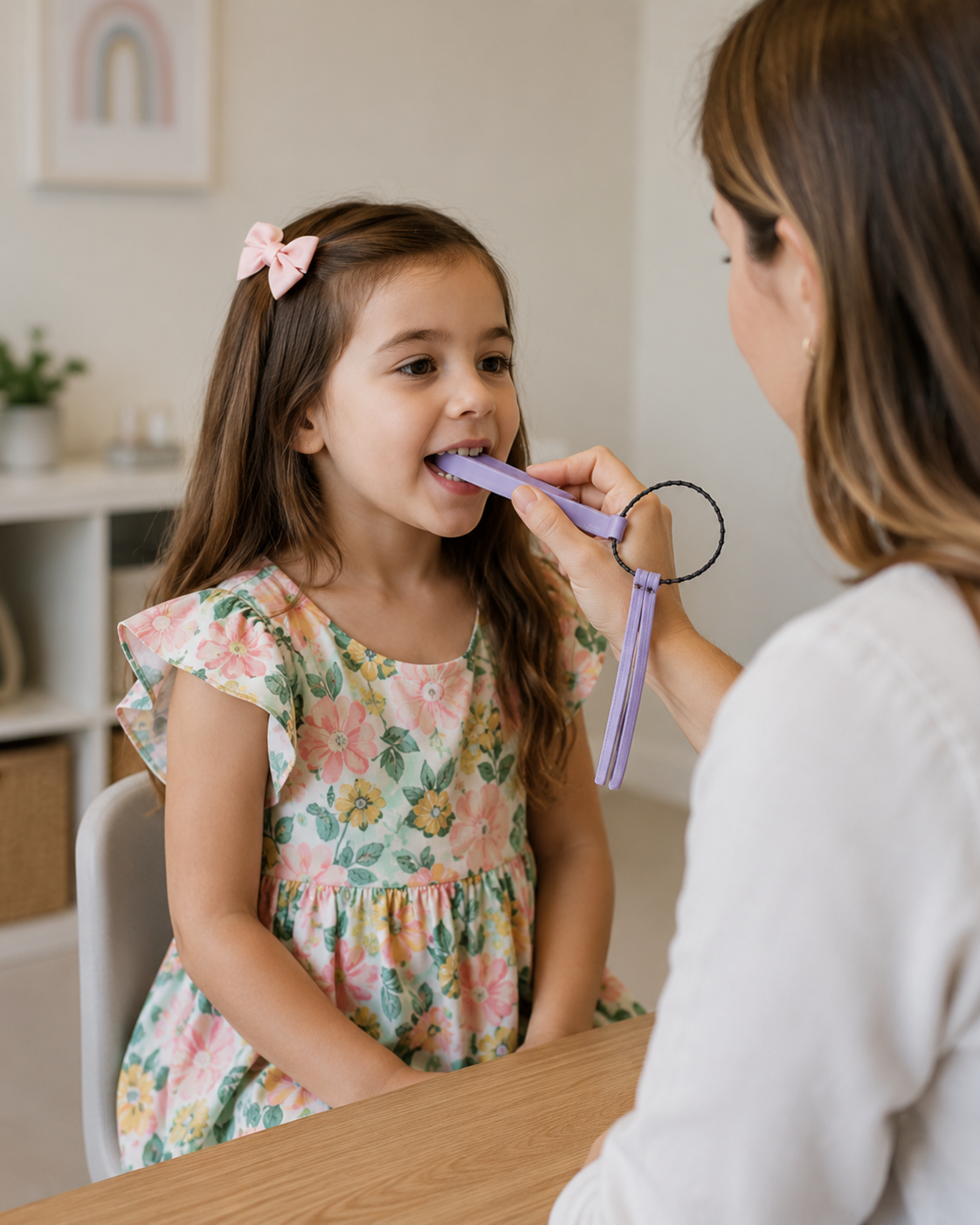
No single therapy approach is appropriate for every child. Every child has unique strengths, areas of need, learning styles, and interests that influence how they learn and communicate. Rather than relying on one specific method, I use evidence-based practices and draw from specialized training to develop an individualized treatment plan that best supports each child's communication goals and long-term success.
My advanced training includes:
Childhood Apraxia of Speech
PROMPT (trained)
TalkTools®
Gestalt Language Processing & Natural Language Acquisition
Orofacial Myofunctional Disorders
Lindamood-Bell® Visualizing and Verbalizing®